You can’t understand today’s labor market without understanding AI. But the clearest signal isn’t in headlines or product launches—it’s in the data.
The annual AI Index Report from the Institute for Human-centered Artificial Intelligence (HAI) at Stanford University tracks, aggregates, and visualizes data related to artificial intelligence. It exists to provide vetted and unbiased data so that for policymakers, researchers, professionals, and the general public can develop a more thorough and nuanced understanding of this complex field.
To understand how AI is reshaping the labor market, Stanford turns to Lightcast—using our analysis of billions of job postings to reveal how AI is quietly, steadily reshaping work. Job postings and skills demand show where companies are actually investing, not just experimenting. When new AI skills start appearing in listings, it’s a sign the technology has moved from curiosity to infrastructure.
Here are four key takeaways from this year's report:
1. AI Hiring Hasn't Slowed Down
In the US, 2.5% of all job postings now mention AI skills. That’s up 55% from last year, 72% from 2022, and nearly 300% over the past decade. What’s especially telling is which skills are growing. The broad “Artificial Intelligence” skill cluster has nearly doubled in demand in just a year.
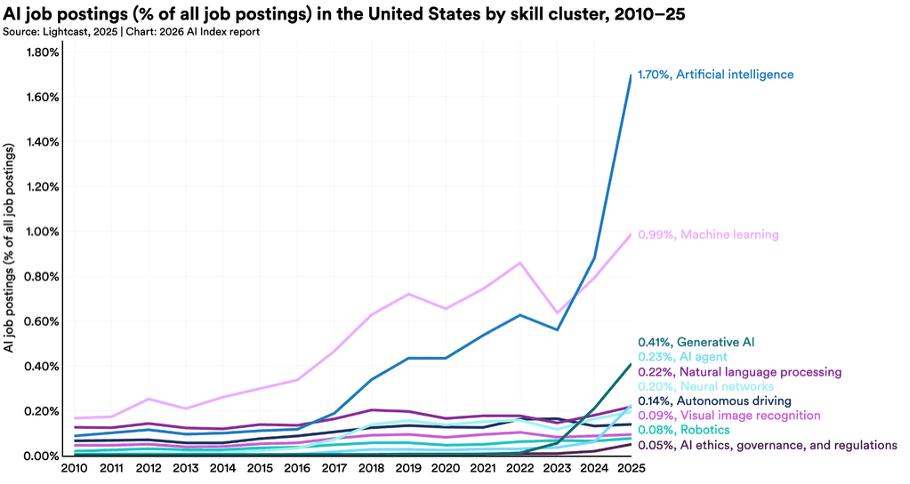
This explosion helps establish what many of us have witnessed anecdotally: AI is no longer a "tech thing," but fundamental across the labor market. Previous Lightcast research has shown that a majority of AI job postings come outside IT roles, and that share has been rising steadily.
Explore More Lightcast AI Research
2. AI Hiring Has Grown Beyond the Chatbot
If 2023 was the year of ChatGPT, and 2024 was the year of generative AI, 2025 looks like the year of agentic systems.
Skills related to Agentic AI—things like AI agents and agentic systems—grew from just 0.06% of postings in 2024 to 0.23% in 2025. That’s a more than 280% increase in a single year, representing nearly 90,000 job postings in the US alone.
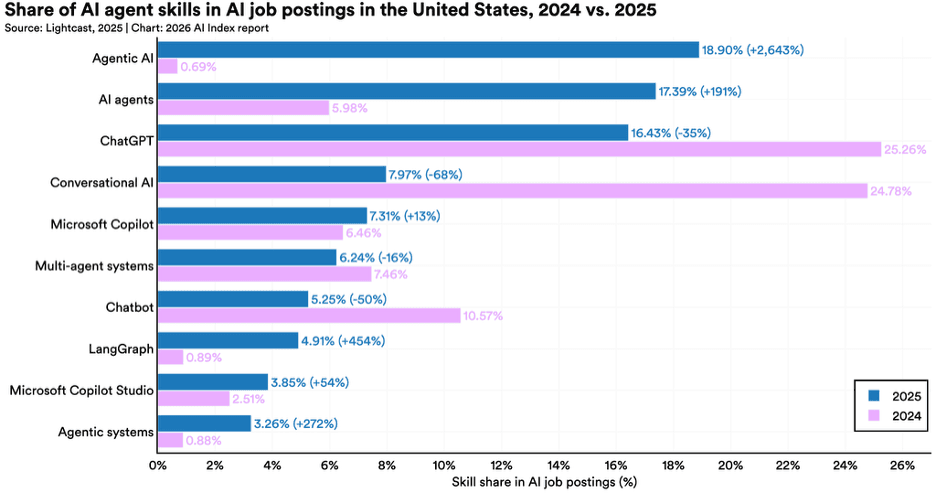
What makes this shift notable is how quickly it emerged. While conversational AI and ChatGPT were already well established, agentic AI skills effectively started from scratch—and scaled almost immediately.
This mirrors what we saw with generative AI the year before, but with a different emphasis. The focus is shifting from interacting with AI to deploying it—building systems that can take actions, coordinate tasks, and operate inside real workflows.
3. The Geography of AI is Uneven
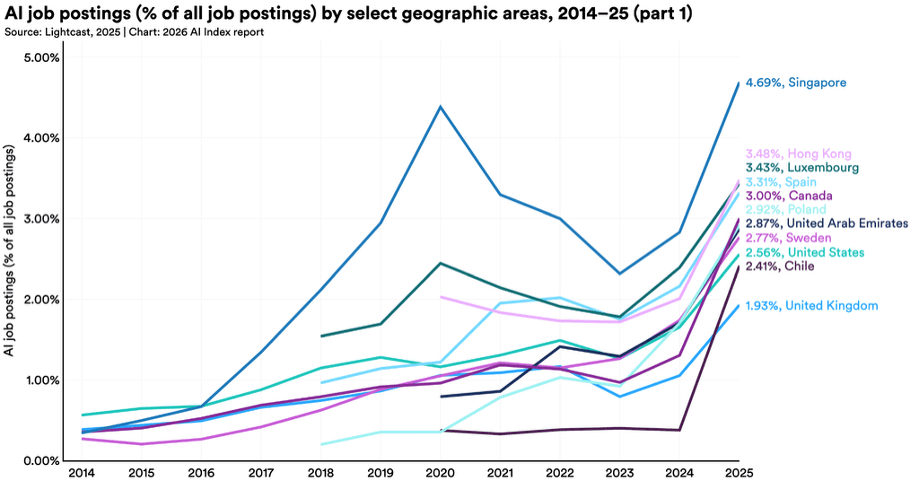
Across the countries Lightcast tracks, the share of job postings requiring AI skills climbed again in 2025. Singapore led at 4.769% of all postings, followed by Hong Kong at 3.5%, Luxembourg at 3.4%, Spain at 3.3%, and the United States at 2.6%. Instead of a single, synchronized boom, this data shows us an uneven map: a handful of labor markets acting as dense AI hubs, while others absorb the technology more gradually.
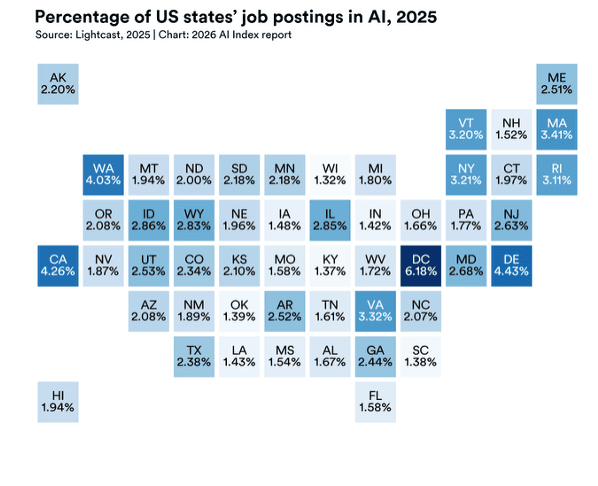
Likewise, in the US, California boasts the highest number of AI jobs (followed by Texas and New York), but the highest concentration is in Washington, DC, and nearby Delaware—where 4.46% and 4.43% of jobs are related to AI, respectively. The high share of AI jobs in DC, Singapore, and Hong Kong suggests that AI jobs are concentrated in urban areas.
4. Hiring Has Moved Away From Experimentation and Toward Execution
As AI moves toward integration into more workflows in more business functions (as opposed to the high-tech fringe where it operated until recently), skill demand has evolved in response. Instead of focusing on technological breakthroughs, postings for AI jobs increasingly request skills that emphasize building and managing systems at scale.
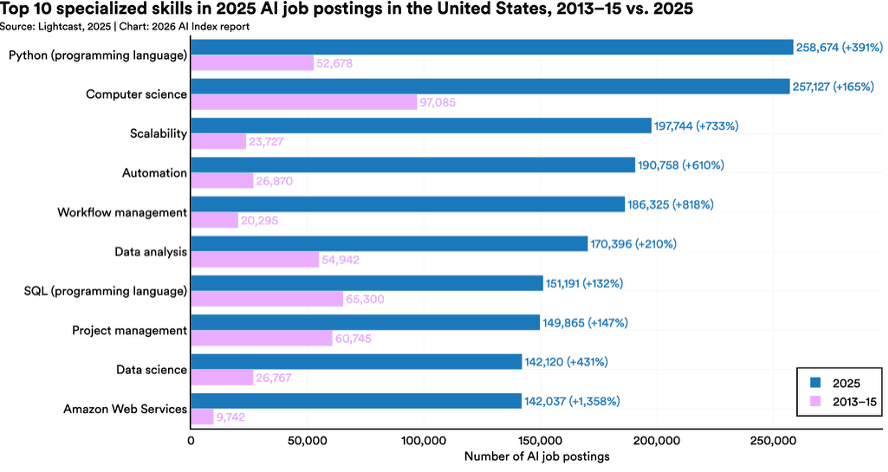
Python was the most in-demand specialized skill, showing up in 258,674 postings—up 391% from the 2013–15 baseline and nearly 30% from 2024. Some of the fastest long-term growth came from deployment-oriented capabilities such as Amazon Web Services, scalability, and workflow management. This indicates AI is moving beyond experimentation and into infrastructure, operations, and execution.
That may be the biggest takeaway in this year’s Index. AI is no longer just a frontier technology. It’s becoming business infrastructure. And the labor market, as usual, is less impressed by the magic trick than by the person who can keep the machine running.
The AI Index shows where the world is heading. We show what it means for you. Lightcast experts are ready to generate detailed AI research for your region, industry, or organization using the same models and techniques we used for Stanford—grounded in real labor market data. We assess readiness, surface risk, benchmark your position, and map a clear talent strategy, so that you know where to focus and what to do next.
Ready for more AI insight? Our research appears in Chapter 4 of the Stanford AI Index Report, or get in touch to learn more about how Lightcast can help your organization become AI ready.