
At every level of the labor market, clarity is crucial. Every worker should be able to articulate exactly what they can offer, every job posting should describe exactly what it needs, and every HR team should know exactly what their workforce is capable of. Too often, jobseekers, employers, educators, and community leaders talk past each other, using unclear terminology that limits how much each side can understand the others.
Skills are the solution, because they create a shared language that everyone can speak.
To help everyone speak the same language of work, we developed Open Skills: an open-source taxonomy of 34,000+ skills gathered from hundreds of millions of online job postings, profiles, and resumes—updated every two weeks. The skills are tagged across our entire data ecosystem, allowing you to see how skills relate to one another as well as the top skills by job titles, occupations, O*NET codes, industries, companies, regions, and even keywords.
But at over 34,000 and counting, we need a system for understanding the taxonomy itself. That’s why created Open Skill Categories.
What are Open Skill Categories?
Skill categories act as a way to logically group the 34,000+ skills in our library. The categories create a hierarchy to easily view related skills.
Imagine looking at a restaurant menu with a list of 34,000 options. Sounds overwhelming, right?
Now imagine looking at the same menu but this time all of the options are broken into categories such as drinks, appetizers, entrees, and desserts. This categorized view simplifies the menu and helps you identify what mix of items you want to order. You can even fully disregard categories of food that don’t seem appetizing, eliminating a lot of options.
We took this methodology and applied it to our skills library to create structured categories and subcategories that easily identify what skills belong to specific career areas, expertise, or aspects of jobs.
Our skills taxonomy features 31 total skill categories.
These categories are broad areas of expertise that map to career areas or industries (i.e., Finance, Information Technology, etc).
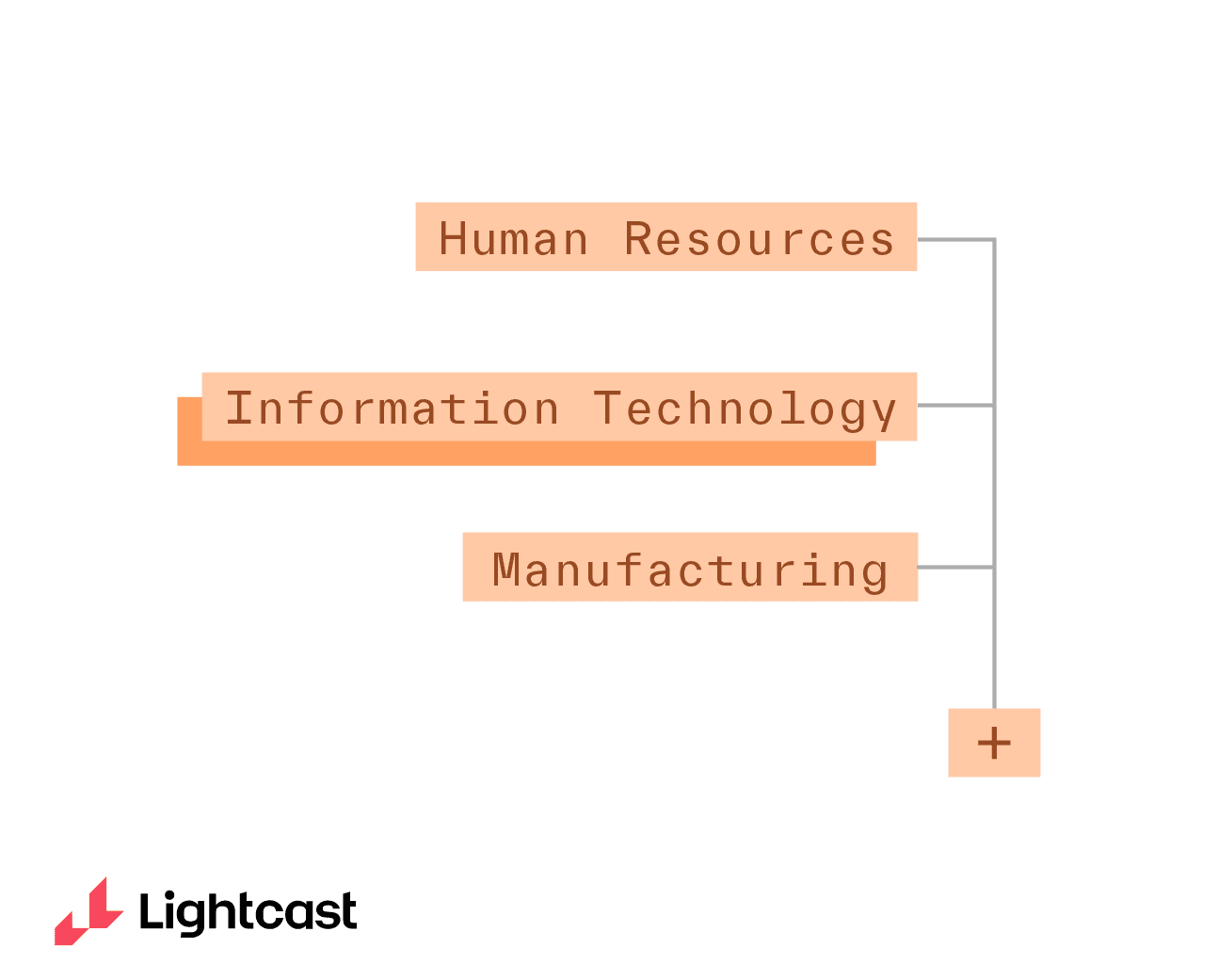
There are over 400 subcategories that exist within the 31 categories.
Subcategories allow the user to divide each skill category into more granular groups of skills. Skills within subcategories can be used interchangeably or in tandem to perform a specific aspect of a job. Each skill subcategory maps to one skill category.
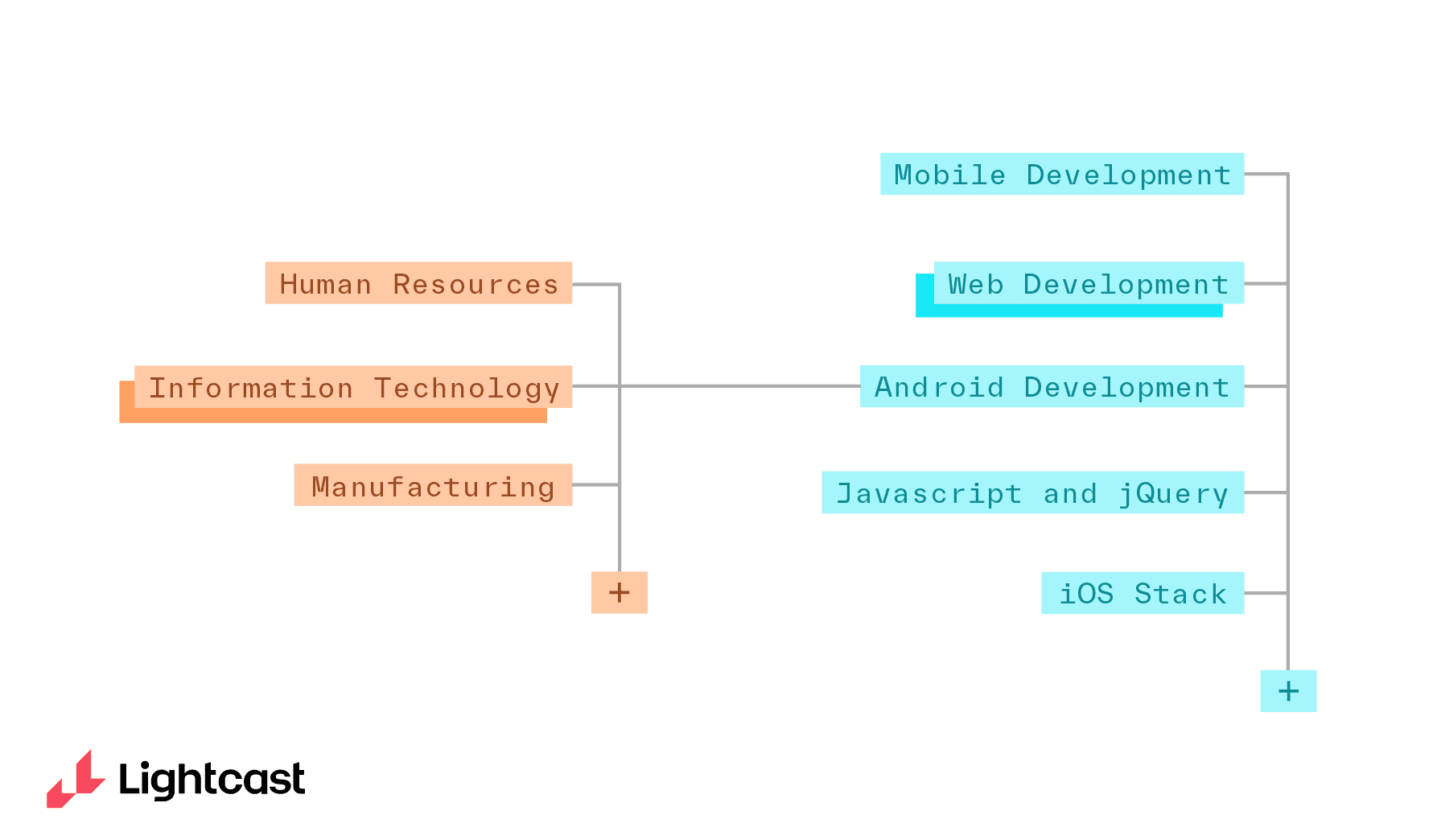
Within the 400+ subcategories, there are 32,000+ skills.
This is the most granular level in our taxonomy. A skill is a knowledge, experience, ability or tool needed to do a certain job or work-related task. Each skill maps to one skill subcategory.
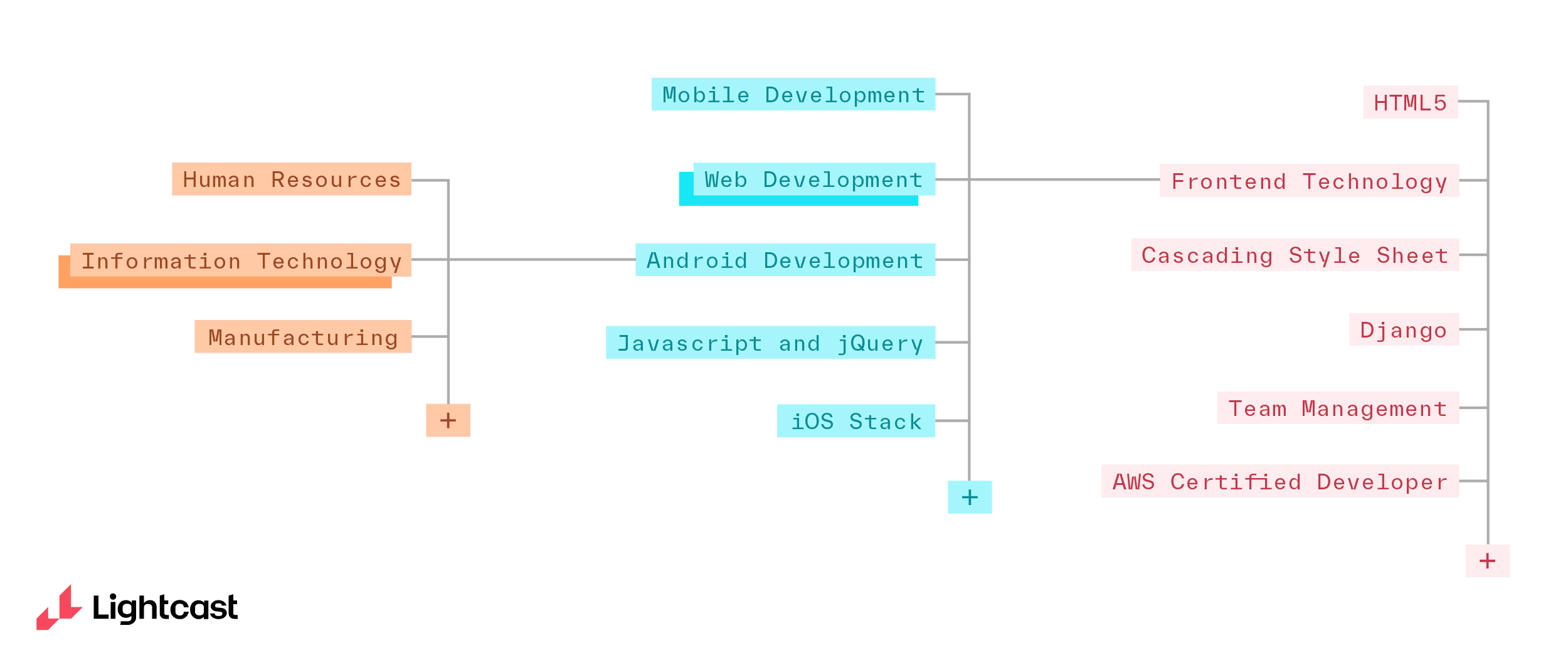
Go Deeper
Within the 400+ subcategories, there are 34,000+ skills.
This is the most granular level in our taxonomy. A skill is a knowledge, experience, ability or tool needed to do a certain job or work-related task. Each skill maps to one skill subcategory.
[DatoCMS Block #42270539]
[DatoCMS Block #MjYSRe2fQWyVUaG_bEYvyQ]
Every job requires a mix of skills—some will be specific to the role (i.e, python), and some more common skills (i.e., communication). To help differentiate skill types, we have 3 varieties of skills in our library: specialized, common, and certifications.
Specialized skills represent the skills unique to a task or ones that primarily occur within a subset of occupations. For example, a Software Engineer might have the specialized skill of Node.js, or Kubernetes. These are also commonly referred to as hard skills or technical skills.
Common skills are prevalent across many different industries and include both personal attributes, behaviors, competencies, and learned skills. The same software engineer could have the common skills of Strategic Prioritization or Team Management. These are also commonly referred to as human skills, or soft skills.
Certifications are not considered skills, per se, but are a collection of skills that are encompassed in a qualification. We include them in our Open Skills taxonomy because they are recognizable qualification standards assigned by industry or education bodies. For example, a Software Engineer could have Microsoft Azure Certification or AWS Certified Developer. Certifications also include licenses, certificates, certifications, cards, and microcredentials issued by a recognizable entity.
Search, filter, organize, and visualize skill data
Let’s say you are creating skill profiles for two software engineer roles within your organization and you want to compare the skills to see their similarities and differences. You could manually compare the profiles skill by skill to see if they align or, you could use our skill categories and subcategories to highlight the areas of overlap. You may find that one role has more mobile development skills and the other has more web development skills.
All in all, educators, communities, or employers could browse the categories and skills associated with each to easily create curriculum, training programs, or job descriptions.
With categories, it is easy to view one industry by the commonly associated skills. A categorized view makes it simple to understand the roles, skills, and certifications required that might be common to the industry. It also allows for easy access to search, filter, organize, and visualize skill data in a whole new way.
Committed to connecting employers, educators, and communities
Lightcast remains committed to providing data that will help connect people and work. A standard and organized Skills Taxonomy can equip organizations to use skills as a common language between people looking for work, work looking for people, and educational programs looking to connect people to the labor market.